
Stability, Pending Approval
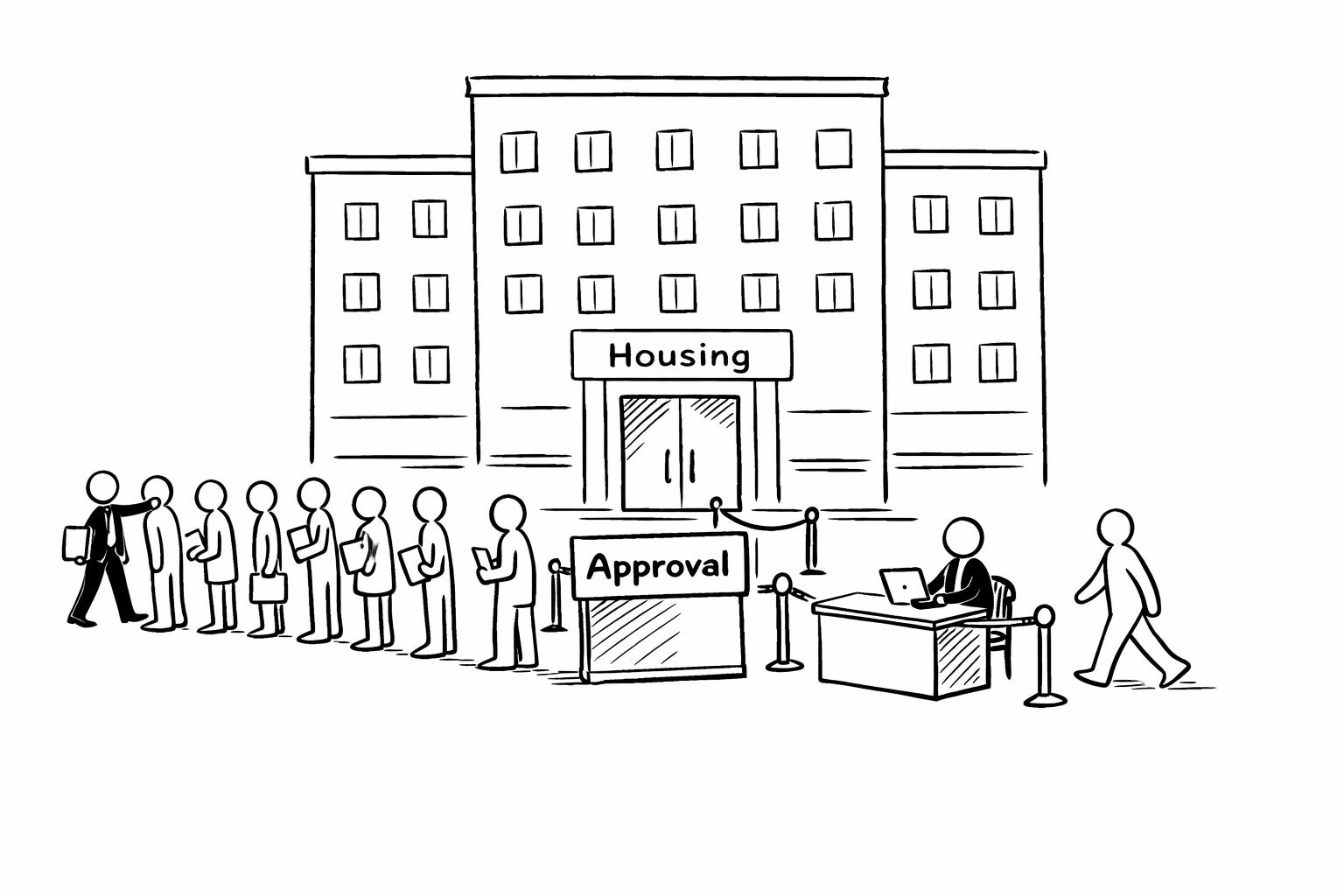
The quiet shift from affording housing to qualifying for it

Structural Reality is a series examining how systems produce unequal outcomes across work, income, and opportunity.
Part of The Access Shift — an ongoing series examining how access is being quietly reshaped across American life.
For a long time, the equation felt simple. If you could afford the rent, you could find a place to live. The process might require paperwork, references, patience — but the underlying assumption held. Housing was primarily a question of cost.
That assumption is no longer reliable.
The barrier has shifted. It is no longer just whether you can pay — it is whether you can qualify. Income thresholds, credit requirements, application fees, and layered screening processes are redefining access in ways that often precede affordability altogether. Being financially capable is no longer sufficient on its own. You have to be approvable.
The numbers make this visible in ways that are hard to dismiss. Nationally, rents have outpaced income growth, with median household income hovering around $80,000. Even in cities considered relatively affordable, the pressure is immediate. In Houston’s Heights neighborhood, one-bedroom apartments regularly reach $2,000 to $2,300 per month. In River Oaks, comparable units frequently range from $2,500 to above $3,000 — implying qualifying salaries between $90,000 and $120,000 under standard leasing criteria. What is being priced at a premium is no longer excess. It is standard.
In higher-cost cities, the conditions are more extreme but increasingly familiar. In New York, renters are often expected to meet 40x rent income thresholds, secure guarantors, and compete in application pools where approval is not guaranteed even when every requirement is met. In Miami’s Brickell neighborhood, rents approaching $2,700 per month require incomes near or above $100,000 — while many households earn significantly less. What looks like an outlier in one market is quietly becoming the baseline in others.
Behind these numbers is a structural shift in how housing systems operate. Corporate property management, automated screening tools, and risk-based approval models are standardizing and tightening the criteria for who is considered a viable tenant. Supply is increasingly concentrated at the higher end, while mid-tier housing — the range where most people once found stability — continues to shrink. Affordable housing requirements and lottery systems exist as partial correctives, but they come with their own constraints: narrow income bands, limited availability, and a stigma that discourages some eligible renters from applying, particularly in mixed-income buildings where market-rate units set the social tone.
None of these shifts feel dramatic in isolation. A higher income requirement here. An added application fee there. But they accumulate. Over time, they form a layered system of conditions that determines who can secure stability and who cannot — quietly, without announcement, and often before a potential tenant ever sees the inside of an apartment.
The experience reflects this. Renters submit multiple applications without certainty of outcome. Fees are paid before decisions are known. Lease terms grow more rigid. And even those who remain housed often carry a growing awareness that their stability is contingent — not guaranteed, not assumed, but approved, for now, subject to renewal.
The implications extend further than the application process. As access to housing narrows, the distance between housed and unhoused becomes thinner than it appears. A growing number of individuals and families are experiencing housing instability not primarily because of mental health challenges or substance use — the factors most often associated with homelessness in public conversation — but because of rising costs and qualification barriers they cannot clear. The line is structural, not personal.
Part of The Access Shift, this moment reflects a pattern visible across multiple systems — in grocery retail, in media, in the spaces where communities once gathered. What were once broadly participatory structures are becoming more selective under pressure. Everyday life is not only becoming more expensive. It is becoming more contingent.
For many people, stability is no longer something you build. It is something you are granted — and can lose.
The Access Shift
The gradual redefinition of who systems are designed to serve.
Across sectors—from public infrastructure to healthcare to everyday spaces—access is no longer assumed. As costs rise and systems face increasing pressure, services once built for broad reach are becoming more selective, more conditional, and less universal. The Access Shift explores how these changes are unfolding in real time—and what they reveal about who is included, who is left out, and how the structure of everyday life is quietly being reshaped.