
The Internet Doesn’t Just Remember Outrage. It Renegotiates Who Deserves It.
The debate over Tom Brady's Good Nut brand and Sexyy Red's response reveals that online audiences rarely apply one standard to everyone. They continually renegotiate who gets to be provocative, who ge

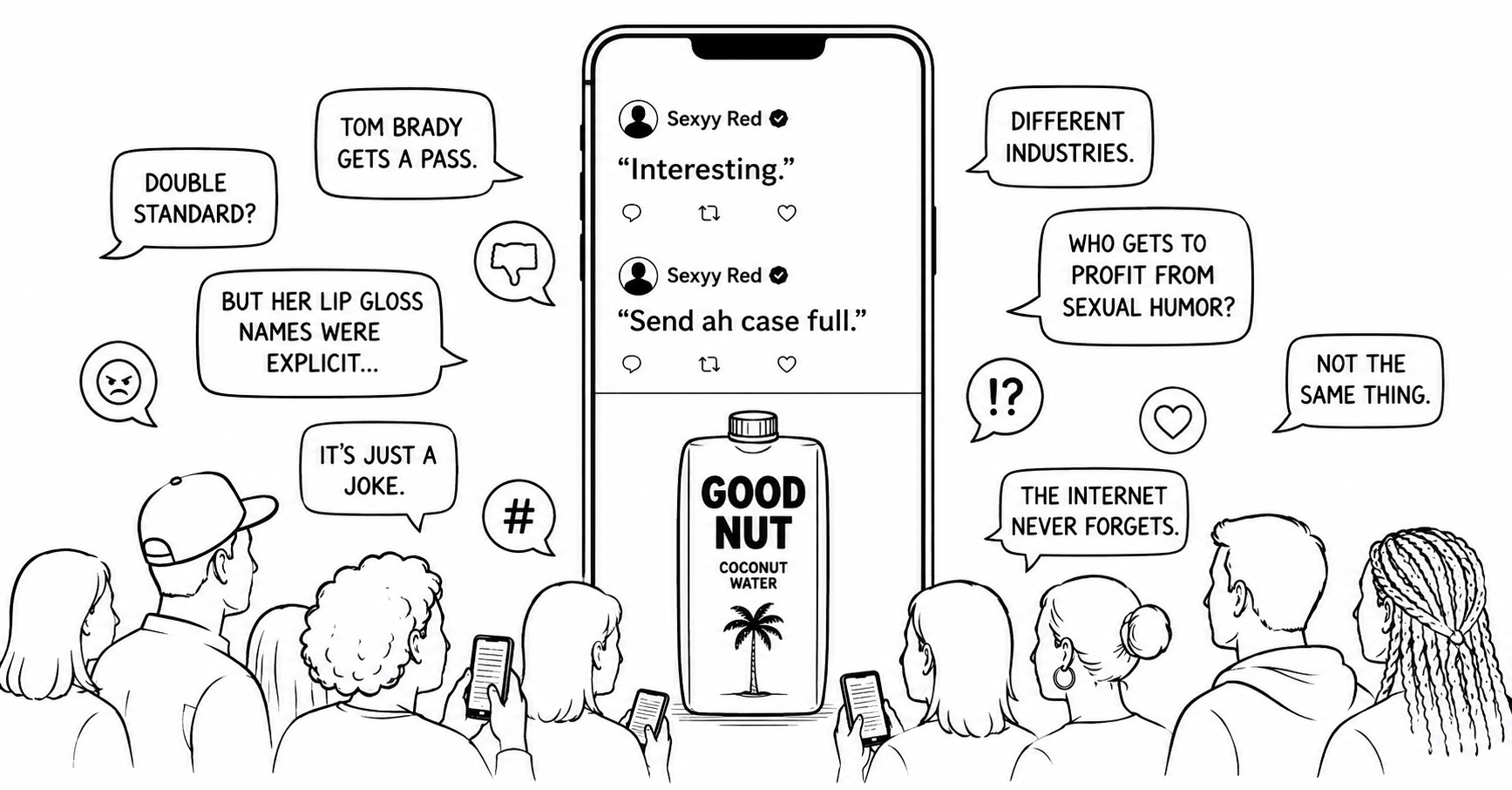
When Tom Brady’s new coconut water brand, Good Nut, began circulating online this week, the reaction was immediate. The name invited jokes, memes, and double entendres. Then Sexyy Red entered the conversation with two short posts: “Interesting.” Minutes later she added, “Send ah case full.” Together, the posts generated millions of views.
The internet immediately remembered something else.
Comment sections filled with comparisons to Sexyy Red’s own cosmetics line, which previously drew criticism for lip gloss names with explicit sexual references. Some argued she was experiencing a double standard. Others insisted the situations were fundamentally different. Still others drew a distinction between a coconut water brand with a suggestive name and products whose marketing leaned directly into sexual innuendo.
Within hours, the conversation had little to do with coconut water.
Online audiences rarely judge a product in isolation. They judge the person selling it. Identity, reputation, industry, gender, race, and years of accumulated public perception all enter the evaluation before the product does. The product is often the last thing being judged. Marketing campaigns do not enter a neutral marketplace; they enter a courtroom where every previous case is admissible evidence.
That helps explain why the same joke can feel harmless coming from one celebrity and offensive coming from another. The same branding decision can be celebrated as clever by one audience and dismissed as inappropriate by the next. Social media does not apply a fixed cultural standard. It renegotiates it in real time — and the negotiation is never neutral.
The reaction to Sexyy Red’s posts also illustrates how collective memory works online. Many users immediately connected Brady’s branding to earlier debates surrounding her business. Others had no knowledge of that history at all. Social platforms compress years of history into a single viral moment. The narrative that wins is rarely the most complete one. It’s the one that feels most satisfying to share.
Millions of people were not debating coconut water. They were debating fairness, respectability, and who society permits to profit from sexual humor without paying the same cultural price. The double standard being argued about is not really about branding. It is about whose irreverence reads as charming and whose reads as evidence of a pattern. That answer changes depending on who is doing the evaluating — and the internet never stops doing the evaluating.
The dynamic will only become more common as celebrity brands continue to blur the line between products and personalities. The internet does not simply archive outrage for future reference. It continuously rewrites the rules about who deserves it, who escapes it, and who is expected to carry it forward.
Get SSC analysis delivered to your inbox every day. Subscribe free on Beehiiv: socialstorytellerscollective.beehiiv.com
Get SSC analysis delivered to your inbox every day. Subscribe free on Beehiiv: socialstorytellerscollective.beehiiv.com